Showing posts with label #Mecha. Show all posts

Friday, March 20, 2026

Titanomachina: A Veritable Chess Match

My opponent remarked that it would be cool to have names for opening moves in Titanomachina, like they do in Chess, and I agree. Usually I think of them in representative terms, like 'ambush' when Titans set up directly next to each other, and 'challenge' when they are set up facing each other down a road-way. But I think it would be something to start naming various manoeuvres and strategies. 

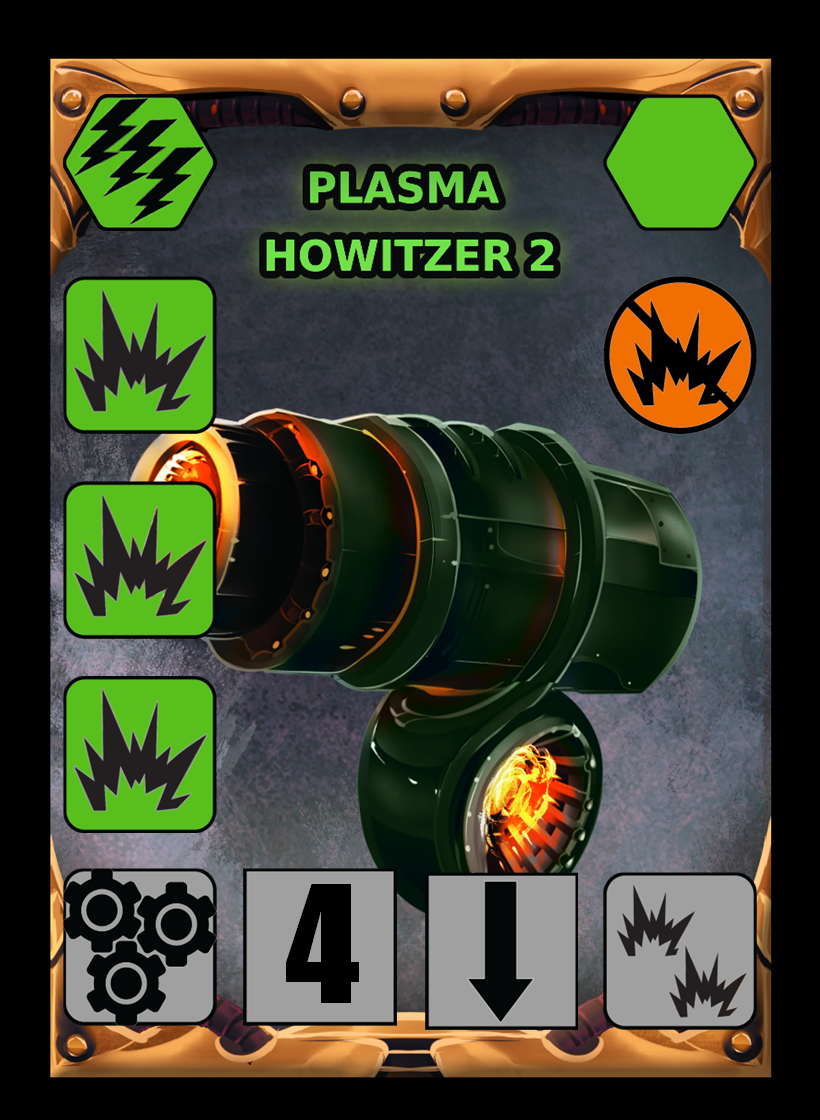
Which is a deft segue into the following Titanomachina battle report that saw something of a reversal from a previous one that saw me operating a gracious Titan against a rapacious Titan. In this battle I took rapacious Eos in Their tertiary configuration with dual plasma howitzers, vulcan gun, and buzz saw  against my opponent's gracious Tethys quaternary configuration with dual rocket pods and matching laser blades. Rather than a running battle, chasing each other around the board, or a steely-sensor'd staring match punctuated by a quick series of precise, shattering blows, this was a straight-up brawl initiated by Tethys when She was set up facing Eos directly behind a row of buildings. 

I had set up Eos to cover both ends of the street with plasma howitzers, but was prepared to swing them both around far enough to fire directly forward where their 180° sponson-enhanced arcs overlapped. The ensuing game proved, somewhat, that agility only really makes up for thick armour and heavy shields when there's space to use it. I realize now that I had boxed Eos in, and didn't place Them well to pivot away from blasting Tethys from a safe distance away from those laser blades. The game ended with a 26-25 Victory Point score in a time-out favouring Tethys, and almost a draw until I recalled that Eos' back-right arm had been too heavily damaged to knock a pink habitat.

What happened?


Eos deploys expecting an ambush, and Tethys obliges...


Tethys flutters Her cyclopean sensor pod as though aiming at Eos through the intervening buildings, but re-routes power as Eos' sponson system spools up. A quick scan assess the situation just as Eos' titanic foot crashes though one of the buildings, and reveals the glowing mouths of Their howitzers. The first one discharges, connecting the two Titans with an arcing stream of plasma! Tethys blocks the stream with a laser blade, and deflects it across Her the armoured faring of Her rocket pod. It's too little, too late as Tethys fires a spread of rockets into Eos, bursting shields and exposing Eos' core. Eos pauses as Their capacitor fires, shunting ichorplasma to Their other plasma howitzer while Tethys seizes the initiative. Eos then discharges Their other plasma howitzer into Tethys' other shoulder, looking to disarm Their opponent. Having seized the initiative though, Tethys' sends Her junior crew scrambling to stations!


Now Tethys stabs Eos, angling for a decapitation, but Eos twists and the searing blade of photons gouges through shields hastily sent to intercept the blow, through armour and length-wise down the barrel of Eos' right howitzer. Forced on Their back foot, Eos braces against the buildings behind Them, and blocks Tethys' colossal follow-up stomp with Their prow, crashing Them back through the buildings behind Them! Eos' front armour is shattered, and Their rear arms are broken! Perhaps importantly though, Their front arms and armaments are unharmed and ready to return the favour...


Tethys swings right around the remaining yellow & pink building, stepping out of the arc of Eos' vulcan gun, but Eos lurches forward to drive a heavy punch into Tethys' face, Tethys ducks absorbing the punch on Her back shields and armour, but catches Eos' buzz saw to the face as She straightens up. 


Now Tethys' crew assembles to operate Her arm as Eos turns to bring Their vulcan gun to bear on Tethys. They wrench Tethys up into a flying elbow drop onto the broken remains of Eos' rear left arm, tearing it off and crushing the deflector array below it in Eos' hip assembly. This wrenches Eos around left, enabling Them to discharge a stream of bullets from Their vulcan gun into Tethys' face, merely splintering armour as She whips shields up off Her leg to intercept. In the distance Eos' roving eye greedily spots an unaccounted blue habitat atop a building..


Tethys' situational awareness is second to none here, and She immediately back-pedals away from the glowing maw of Eos' re-charged and fully operational left plasma howitzer. Eos' right plasma howitzer isn't fully operational, but it manages to spit out enough plasma that Tethys is forced to block with Her shielded left leg, leaving Her right shoulder open to a solid kick that smashes the remains of the rocket pod off!


Tethys arrests the momentum by having Her junior crew swing out Her arm and catch a blue building to step out of the arc of Eos' left plasma howitzer and Eos turns and steps back in case Tethys is thinking of inserting another laser blade into Their hull, but Tethys' position at the very edge of the battlefield ferments a notion in Eos' many heads as They fall behind on buildings and body parts...


Eos charges in with a savage punch, wrenching Her around and exposing Her savaged back armour. Tethys is not inactive though, and has Her crew aim a knock-out kick to Eos' right leg, and only the hasty intervention of Eos' vulcan gun sees the fight continue despite Their dismemberment. Eos' return back-hand hammers Tethys back but Tethys takes the hit on Her opposite leg to slash Eos with Her laser blade as Eos discharges Their plasma howitzer. The exchange leaves Eos with a damaged buzz saw and another broken arm, while Tethys' rocket pod explodes!


It's nowhere near enough though, and Eos staggers away, hoping that They can equalize the score on buildings. Tethys isn't done with them yet though...


As Tethys lines up a final stab, Eos spots a tall blue building in the west and staggered south-west waving the stump of Their back-right arm as though They could knock down one more pink habitat. Tethys is left with victory, although perhaps not the gory knock-out Her crew was hoping to achieve.

In terms of learning from my mistakes, I think primarily it was not setting up where I could take the best advantage of Eos' forward armament and all Their arms to clear pink buildings. Tethys' player did a great job of starting with a building advantage and then cramming laser blades in Eos' face to distract me from that deficit. While I took Eos Tertiary with the objective of oppressing my opponent with plasma howitzers, I think that would have worked better had I used the crew to aim them rather than relying on snap-shots, as I don't think I was able to really exploit the shock effect as well as I could have to push a card advantage. 

There was some discussion about vulcan guns, particularly the use on round 4 as a single big shot rather than several smaller ones, and I think I have changed my mind, in that the single shot did not really work to inflict damage, while several smaller shots would have cleared the shield coverage that kept Tethys in the game. My opponent did a really good job of using the shield systems to maximize Tethys' initial shield coverage rather than wasting time and power restoring it, which struck me as clever. I think that's potentially how I lost the card advantage, because my opponent was able to distribute damage more evenly and that's pretty clinch where the Titan is also gracious. In a game where 1 can be a big number, and stand between scoring 3 and 0 points, I think it made a big difference. Multiple shots might have overwhelmed that strategy, clearing those rocket pods faster, and getting more 3 cog shots against Tethys' surface rather than Her shields. 

All that said, after the game my opponent noted that in round 5 that Tethys had turned further left than She should have, moving Eos out of the arc of Her laser blade, and preventing an early knock-out. But importantly that did not happen, and while part of the design is to enable players to identify and analyze mistakes in play with an eye to improving as players, another part is to allow players to make mistakes (and to allow other players to capitalize on them). A perfect game is possible, but I like to think it remains an open question what that would look like.

Certainly the game was an interesting switch-up from the more careful, more studied games of late, and as a designer its nice to see how pitching into an immediate exchange of blows right away is a legitimate strategy! As a nod to Chess, perhaps this should be called the "Hammer's Gambit."

Monday, January 26, 2026

Two Legs Good, Four Legs Better


Making Eurybia into a centaur. As with some extreme configurations you have to give something up. Two plantigrade legs at the cost of the rear armour (Extra Armour 4) and a coolant system. It also has a rear sponson mount, for a rear-facing weapon, because it is a centaur.

Weapons-wise I think two gun batteries and a laser blade in the rear mount. Or perhaps two claws and a laser battery. Either way, the plan is to deploy in the middle of the board and work the danger zone with legs and range 4 weapons. In terms of opponents this is figuring Rhea Quaternary's guns probably want to occupy the same space. 

Six cards for Limbs, four cards for crew, three cards for weapons, two for shields, one each for sponson, sensor, and coolant, four extra armour. Full crew and weapons requires 10 cards, leaving sponson, sensor, coolant, and three extra armour. One extra armour if the last two are activated. 

The coolant proposition is to replace two actions with a repeated action next round. It's not great until that repeated action is above the curve, 1 charge to three cogs like firing a macro gun, or operating with master crew. Because it levels out that 1:1 ratio of cards spent to cogs used. 

In which case a laser is the perfect weapon to shoot twice. The laser blade hits hard for that above-the-curve effect, while the laser battery might be more effective in volume where the first shot might soften shields and waste defensive action. A claw that can plow another Titan through a large building would also be on the menu. That or just keep the master crew running cool.

Friday, January 16, 2026

Titanomachina: Eos vs Eurybia

Last week I played a game of Titanomachina that convinced me that I needed to separate out the extra content from the Tabletop Simulator DLC. So I put the extra Titans, usually arranged in a corner, into their own DLC, and likewise removed the Formicide infantry expansion to its own DLC. At some point soonish I'll make them both public-ish. Why haven't I done so sooner? The hand of moldy old Babylonian Nergal.

All that aside, what happened? Well, I was crewing Eos Senary against Eurybia Primary and it seemed like I was winning, despite being behind on buildings, and prepared to do a ring-out/knock-out combo when the connection crapped out and could not be restored. Eos was gracious, and it turns out that the Senary Configuration is brutal with those dual capacitors behind it. Which is funny, in a sense because Eurybia Primary gives up the plasma shotgun for a vulcan gun, and my opponent noted that he should have used the coolant systems to maximize the crew operation so it should have been Eurybia bulling Eos around the board.


The fact that the habitats are 25mm cubes in their meat-space prototype should alert players to the fact that Titanomachina is a game of inches. I set up Eos in a dead-zone off Eurybia's starboard prow for an aggressive start, utilizing Eos' gracious personality against Eurybia's sagacious personality. I wouldn't have the initiative, but it made my opponent decide whether they were going to turn and fight, or attempt to lead me on a chase. But first, junior crew got into position...


A chase it was, but despite equivalent foot-speeds, Eos' jump jets gave Them a distinct advantage to close, and being in the reaction position let me push Eos in. It's worth noting that half the game here was not merely the promise of damage, but also the promise of card-advantage. Remember, I had a plasma shotgun, and even if it didn't do interesting damage, it was still going to shock Eurybia and force a discard. What I gave up could be equalized.


Then it starts, sponsons activate and it's go-time, I swing Eos around the corner of a row of buildings and as my opponent hammers some blue habitats into mulch I get a flight of rockets into Eurybia, destroying Her back armour and shields as She ducks. While it doesn't compare to the habitats Eos has lost, it cracks open Eurybia's defenses in a satisfying way. The rocket pod is, after all, the least of Eos' weapons.


Now because Eurybia is retreating along the edge of the board, I'm able to step backwards and re-address, and slightly against my better judgment (and making sure I have an avenue of retreat in case I need to fire Eos' jump jets) try for taking the initiative so my opponent can't dodge. Since that takes Eos through a yellow habitat all the better. That doesn't really work, but the intent is also to try and get my opponent spending precious power on an initiative Eurybia may not need either. Then a friendly blast of plasma to help equalize that card advantage.


Now it's Eurybia's turn to strike back, reversing course and rampaging back down that winding avenue and Eos fires those jets to make sure Eurybia's laser blade isn't buried in Their back. They brake on a yellow habitat, and a capacitor fires to keep them in the fight as Eurybia vents coolant to signal She's not slowing down.


Eos now takes something of a breath as junior crew scramble to stations inside Them, and swings back around to stalk after Eurybia. Eurybia hasn't stopped moving and presses the lead on surviving habitats detected on the board. It's a strong defensive move because if Eurybia is knocked out, my opponent may still win from an insurmountable lead; the damage to Eos' population may be too much. The upshot is that Eos has to be very careful to avoid triggering a knock-out before the damage done to Eurybia outweighs the damage to Eos' habitats. So a careful application of rockets should offset Eurybia's attempt to recover shields over Her remaining armour.


Eos has a good firing firing solution, blasting away with the plasma shotgun, looking to spread the damage and clear Eurybia's shields before executing the knock-out with enough damage to offset Eurybia's 5 VP lead. Her systems are locked and loaded, and even junior crew can make a laser blade really hurt. Yet Eurybia is building up to something, something that might see Her scrap enough shields and armour off of Eos to stay in the game, but She's backed into a corner. However, the game ends on a time-out, as something about the DLC (possibly all the stuff that makes loading it kind of slow) times out the connection. The decision of the Hecatoncheires orbital installations cannot be questioned...

Could I have won? I think so. Would I have won? In the past week I've been pretty confident that I could have forced a knock-out/ring-out with the cards I had in hand and the cards I recall from rounds 4 and 5. Keeping track of games by taking screenshots at each round really helps, since it acts like something of a study aid. 

There is also, to a degree, an opponent style, plus the commitment to a direction. Eurybia lacks jump jets for speed and using a coolant system to super-cool a limb gives you a walk for the same cost, with some trickier timing. 

Timing is everything. The game is set up so that your ability to react to your opponent offsets their ability to react to you. Generally speaking it is perhaps an open question as to whether having the initiative is always good. I think I was doing very well despite being behind in the habitats. After all, a knock-out/ring-out. My opponent pointed out the only system I could score with the laser blade would be the arm mounting the vulcan gun, which is a fair point, with other systems triggering a knock-out loss for me. If my opponent did nothing else to Eos in the meantime, despite the master operating initiate crew, it would be a tie then. 

Yes, my hope is pinned on the Eos Senary Configuration's smooth capacitor action to just hammer Eurybia. I don't think I played a deflector system in the entire game. I think I recall having card advantage at that point, 

Which leads me to a second point as Nergal's hand lifts from my chest, that now I'm torn between taking Eos in my next game or taking Eurybia's Tertiary Configuration, with a gun battery, laser battery, and hand. Which is funny because the first and third choice would be Eos Primary and Eos Tertiary. 

Friday, June 6, 2025

Titanomachina: Eurybia


The Primary and Secondary Configurations, tentative, for Eurybia would be: sensor (1), arms (2), plantigrade legs (2), shield generators (2), sponson (1), extra armour (5), crew (4), and coolant (2). That's thirteen systems requiring no extra charge, twelve if you consider Detect mandatory. If it is, then it's five systems requiring +1 charge (one card played face-down), and two requiring +2 charge. So without activating shields or weapons Eurybia may do 12 + 5 to move 4-6 times, activate sponson or sensor more than once every four rounds. But what do you give up to get that? Giving up two cards (one coolant, one face-down to +1 charge coolant), probably extra armour or shields, to de-activate one (or more with crew) activated system. Using initiate crew you could de-activate two systems already activated. Including the crew... Of course that is the same as not using an initiate crew, and different than not including the crew. Activating two limbs could be a good use of an initiate crew, a coolant system, and the power to extra armour 4 & 5, or even a shield generator. 

Which brings me to weapons. A rocket pod so Eurybia doesn't have to chase, and a vulcan gun, laser blade combo. The vulcan is defensive, but reactivated and operated by another crew member it could win a game. The laser blade is because it combines well with a rocket pod. Which all sounds pretty incredible right? It's like having two extra copies of weapons except you're firing two rocket pods at the cost of six cards, the rocket pods themselves, the charge for them, super-cooling to deactivate for a second activation next round, and the charge for that. Two separate rocket systems would do that with four cards. To activate all weapons the primary configuration will require seven, eight to ten if you want crew in on it. That leaves 12 cards for manuever and defense. 

More importantly not only do the coolant systems make the primary configuration less predictable and more agile, it can also be pushed to make the Titan faster and hit harder. 

The secondary configuration ups the ante to make the range shorter and the threat bigger. Using coolant on the claw and getting in multiple grapples into buildings, or simply into arc of the laser blade, may make up for an inability to multi-task offense and defense. She still has the best armour and shields in the game, and can leverage that hardiness to absorb damage as well as prevent it. 

It's worth considering that using the coolant system will leave Eurybia dead in the water, spending at least one other card, leaving itself in place to be shot and two cards short on defensive options. It's not gaining anything until the next round, so using it might signal that a player can do nothing else.

Either way, it'll be interesting to get these two out on the board to see what happens. 

Wednesday, May 21, 2025

Titanomachina: The Gripping Hand


I saw a picture of a Jenner from BattleTech where someone gave it hands and tried it on Styxx tertiary for a laugh. And you know what, I want to see what it can do? I have a theory that it may get shot up chasing an opponent, but may be able to control the initiative and cover using Her sensors. I think you would want to have lower initiative until you can attack with hands and then with legs. 

Hands, Digitigrade Legs, Thrusters, Deflectors, and Sensor-detection all require a charge of one other card. So that is 20, with senior Crew taking another 4 for 24. That leaves -2 other cards for junior Crew, Turrets, Extra Armour, Coolant, and Capacitor. 

Round 1
A hand, a leg, the master crew, coolant, armour, a sensor, a deflector, and a capacitor 

Round 2
Thrusters, turret, armour, sensor, initiate crew

Round 3
A hand, a leg, the adherent crew, armour, deflector

Round 4
Thrusters, turret, initiate crew, sensor, Personality

Because it occurred to me that you could use the coolant system on the master crew to double their bonus, admitted to two different systems, but for an additional cost of four cards, the master crew and the coolant systems and their respective. Where you only have two weapons, you need this bonus as much as possible. You will also need those legs more than twice a round. 

Turrets not only let a Titan open up a weapon to 270 degrees, but jumping 180 degrees up to three tiles can be both a good defensive or offensive move. You need to close to act directly against the enemy Titans, and you likewise need to dodge out of the way if an opponent is so unkind as to try and hit you back. If you go for a neutral start and try to build cards to start attacking on round 3, you can mix jump and attacking with hands rather than walking and attacking and attacking with hands. Because, ideally, you use the hands to defensively grapple the opposing Titan, and blow out their shields with their massive shield breaker bonus. Once down to 40% or so, there will be big enough gaps in coverage to do some armour shattering kicks. With around four activations to attack with the legs that'll net you four extra armour cards at best. That is if each kick gets three damage past shields. It might be something to operate the hands instead, opening up the legs to keep the Titan pointed in the right direction. Probably depends on the situation at hand...


Oh, and yes, I also updated the Styxx tertiary and quaternary dashboard cards on TableTopSimulator to swap the position of Deflectors and Thrusters in the back-left and back-right stacks of the Titan, with the notion being that Deflectors are supposed to ablate damage and being fewer HR points than Thrusters should be at the top of the stack. 

Monday, March 3, 2025

Titanomachina: Multi-Titan Mayhem

I've been wracking my brain, trying to figure out how players could play multiple Titans at once without it becoming unplayable, and here's a first draft of what I've come up with so far: 

Players draw a card from each of their Titans' decks each turn. In initiative order players choose to: 

  • play a card face-up, activate it, and resolve the subsequent actions,  
  • play a card face-up to be activated later. 
  • play a card face-down to charge another card from that Titan, either for immediate activation of a face-up card, or for later.  
Cards can only be activated if the player has built up sufficient charge (face-down cards), either because they have enough cards already face-down in play, or because they just played a card face-down. 

After a card is activated and its action(s) resolved, place the card on top of any cards needed to charge it on top of a discard pile. Once a player can no longer draw cards, this discard pile is flipped over. 

  • Capacitors act as charge cards when they're activated. 
  • Emergency Power lets you recover a card with block or intercept from the top of the discard pile and play it in reaction to an attack.
  • Shock has players add the next card at the top of their deck to the discard pile.
Rounds end after five cards have been drawn, whether they're activated, left un-activated, or used to charge activated systems. Charge cards and un-activated systems (as well as activated crew) persist past the end of the round, although twist actions, detect Titan actions, and body slams do not. 

Edit: Players get three unactivated systems out on the table to begin the game. I also need to figure out how to count those rounds better...

Further edit: Someone on Bluesky made a very good suggestion for players to put a pass card five cards deep in their decks at the beginning of the game and every new round. 

Tuesday, February 11, 2025

Titanomachina: Eurybia Configuration 1


Here's an initial version of a dashboard card for the Titan Eurybia, using the new Coolant system and a Capacitor instead of Rhea's Thrusters, but sharing in Rhea's abundance of Extra Armour systems (and crew, but when I finally find the cash to buy more art for crew cards you can bet Eos, Styxx, and Eurybia get all-new crew). It'll be interesting to see how Eurybia gets on with no jump jets in Her primary configuration, but it may be a while before I need to worry about Her tertiary and quaternary configurations; trying to squeeze Her model down to well under 2MB is proving to be challenging. 

Speaking of challenging, aside from a variety of melee weapons, I thought it would be fun to introduce some new additional effects, starting with Recoil. Represented by a grey icon with a black arrow pointing down, the inverse of the Impact icon, Recoil would affect the Titan using the weapon to attack. Each attack would either push the Titan back opposite the direction of the attack's target, or turn the Titan 45° left or right depending on low-angled (between 0 and 45°) shots. 

This naturally had me thinking of the Kzinti Lesson from Larry Niven's Ringworld: "A reaction drive is a weapon, powerful in direct ratio to its efficiency." Which is to say, if you de-couple the cavitation converters on a plasma weapon, you get plasma jets! I would update the card art and label as well, eventually...


Friday, July 5, 2024

Titanomachina variation


What if we took all the habitats off the board? And we go back to starting from an empty board? The question, of course, being how to put them back on the board... 

The easiest way is using sensors. It leaves the game as is. In a 9-round game a single-sensor system Titan can place 16 habitat buildings in towers of 8. At best. A three-sensor system Titan can place 22 in the same 9-round game. 

There is also the issue about perverse incentives for putting buildings on the board. On the other hand, destroying line-of-sight blocking terrain has the effect of exposing oneself to retaliatory fire. It also wastes an attack on a building. Players aren't restricted to only placing their own habitat blocks though.

If we did this, the numbers on the Titan dashboard cards could represent a starting score. 

Originally the notion was that the Titans would be able to place habitat blocks as they move. I don't know how to make that work. It was intended to give an empty board something of a fog of war effect without clumsy extra counters. 


Friday, May 17, 2024

Titanomachina: The Goal


I updated my prototypes with new cards and a board to reflect the changes made to the Tabletop Simulator version. The old prototype vinyl board I've used as something of a back-drop to distract from the flooring in my apartment. I've also noticed that three production personality cards (Sagacious, Rapacious, and Gracious) all have matching pass cards, so I've worked up one for Pugnacious. I've put it up in TTS, and I think it'll be in the production version. Likewise the production version should contain some dry-erase markers for marking up the damage diagrams in their sleeves. 

Otherwise the set would be:

  • 1 Rule book
  • 1 Titanomachina Game Board
  • 4 Titans (siocast?) or 4 plastic pawns w/stickers
  • 108 cards including personality, pass, damage diagram, shield diagram, and system cards
  • 100 habitat blocks (siocast) or 100 blank dice w/stickers
  • 2 Dry erase markers
  • 40 Shield tokens
  • 1 Box and insert


Monday, April 29, 2024

Titanomachina: Tactical Analysis

 Lately I've noticed that I can free up cards for the Damage Diagram, Shields Diagram, and Pass cards in each 55-card deck by making the secondary configuration of each Titan a weapon-swap with another Titan. So instead of Titan decks carrying 12 weapon cards each, they would have 6 each for a complete set of 12 together. In some cases, however, the weapon swaps aren't quite so easily straight forward. For example, Tethys primary to Styxx secondary.


With Styxx sporting a Gun Battery 2 (right hand gun battery card) and Tethys with a Gun Battery 1 (left hand battery card), and both a Claw 1 (left hand claw card), it means that I would need to either use the 55th card slot in each deck to carry an extra weapon card, or I would need to swap Tethys' gun battery and macro laser. I mean, I could swap Styxx's weapons, but that's a good configuration. 

Swapping Tethys' medium and long-ranged weapon would create something very like Rhea's primary configuration, with a left-shoulder laser and a right-handed gun. Certainly Tethys would still have a capacitor instead of a 5th extra armour, and jump jets where Rhea has thrusters, but it seems kind of same-y, or at least not showcasing the difference the placement can make. 


I think the clincher might be that both the hand and the claw weapons can grapple an opponent across into their left or right hand quadrants. This is most useful for opening up a target to stab with the laser, I think, but also for slamming them into a sufficiently large block of buildings. While the macro gun is good for the occasional snap-shot, the gun battery requires crew operation to get the most out of it. Additionally, Tethys' secondary configuration already carries a laser blade in its left arm.


Tempo-wise, Tethys would need to spend three cards to grab with the claw, and then at least three more to shoot with the macro laser, possibly five to operate the weapon with senior crew (adherent, master). That would also be a chain of three actions, possibly four if a capacitor is used to regenerate the cards spent on activating the claw to fire the macro laser. Five cards for a crew-operated attack in two actions might actually be best, as a 5-cog attack with a laser is going to amputate something even under two shield tokens. Having that on both sides of the Titan might be best, with the gun battery backing up the claw at range. A macro gun would do a 5-cog attack in two actions (operate, attack), for four cards, but it would take five cards and three actions (operate, operate, attack) for a hand to do that. I think there's an edge there, removing a part of the enemy before they act with it.

So if I go the other way and use the 55th card for a Gun Battery 2 to make the conversion to secondary configurations workable, then that suggests I could use the 55th card in the other deck to do something similar. I'm leaning towards a reference card illustrating the incoming and outgoing arcs though.   


Friday, February 2, 2024

Forming a Green Strategy

Styxx is difficult to use, especially when it mounts expensive Charge 2 weapons. In part this is because the player will find themselves facing opponents with a card advantage of having more cards in hand with the opportunity to make more actions. Styxx players are forced, almost, to play more slowly, at a lower rate of activity than players with other Titans. This can be ameliorated by the green player holding off on the initial rounds to build up a big hand of cards they can use to match an opponent's rate of activity. That is pretty unfriendly to a new player though, trying to keep up with the other players and not the tempo dictated by the Styxx cards. 

Take Styxx's primary configuration, for example. In order to use both arms and both legs, Styxx needs to spend 12 cards (including the arms and legs). Rhea, Tethys, and Eos primary configurations only need to spend 8 cards. Now Styxx may get 10 cogs to Rhea's 6 cogs, for all that, but there's a question of when and where that makes those four extra cards mean something important. Notably Styxx may only use Her legs, spending 6 cards for 6 cogs, but that is two actions to Rhea's four. So either Styxx is giving up a card advantage, or a tempo advantage. 

Likewise Rhea's primary configuration can use all three weapons for 6 cards (for 5-8 points of damage) meaning Rhea can move and attack at capacity for 14 cards. Styxx primary can use all three weapons for 8 cards, meaning moving and attacking for 20 cards. That gives Rhea 9 cards to enhance movement and attacks with crew (their entire crew) and then cards to block and intercept attacks. Styxx gets 2. One of them is a capacitor, but that makes it equivalent to 3 cards if it's used at its basic effect. Where can Styxx get those six cards to make up the difference? It's going to have to be weapons, and possibly the thrusters. If we swap out the laser blade and plasma shotgun, that reduces 6 cards to 2 cards. After that, the rocket pod can be swapped for a laser battery as a dead heat, but also for weapon synergy. Take out the thrusters for a second capacitor, and that is 12 cards for limbs plus 4 cards for weapons. That's 16 cards, leaving 7 including two capacitors for an effective 9. 

Styxx's tertiary and quaternary configurations have similar issues, but have a slightly different flavour due to these configurations lacking arms. With legs and thrusters and sponsons, and only two weapons, these configurations of Styxx need crew to ensure those shots Styxx takes don't miss and hit hard. That's 12 cards for 10 cogs (and 90-180 degree arcs). Setting aside 4 cards for senior crew and their charges, lazy gits that they are, that leaves 7 cards for shooting and sensors. Including the two capacitors, that means a Titan may be able to activate legs and weapons at the same time, leaving 5 cards for sensors (two for detection, one for scanning) and blocking with extra armour. Weapon-wise, it's going to need to be guns, rockets, and maybe a laser battery. It's kind of funny to be returning to those historical roots in Adeptus Titanicus (1989) where a Warhound Titan would have a turbo laser and vulcan gun...

Monday, October 9, 2023

Titanomachina: Simultaneous Activation


In my efforts to figure out an additive way of speeding up the game, a friend and guru of mine suggested that we try activating simultaneously. Usually in Titanomachina we would take turns both activating systems and resolving their actions. I resisted because in order for this to work, at least with the minimal amount of change to the rules, I would need cards for the pass option in each deck; two cards where a 54 card deck contained two Titan decks with their optional weapon loads. 

But having tried it a few times in two-player game, I think it works to both speed up the game, and to perhaps make the game a tad more exciting. I rather like how Titanomachina ratchets up the tension for the players because reactions are limited to parts of a Titan being targeted during attacks, and there's a wonderful economy by which players try to play off combos against combo-breakers. I enjoy how the tension builds and then releases when some manages to pull off a crushing blow or clover combo. 

Where players are activating simultaneously there's additional pressure to play a card quickly, and keeping the actions resolved in initiative order it makes initiative even sharper. There's some tension leading up to players playing cards, which releases when the cards are flipped. It works. However, I feel like these mini-build-ups and releases of tension are more of a side-grade to the overall build-ups and releases. Usually after a game I'm very excited because of the way the tension isn't exhausted by the pay-outs, but in this case the constant release of tension meant I was pretty relaxed when it was over. On the other hand the response from my test-cogs was pretty positive, and I think it's definitely one way Titanomachina could go.

Production-wise, putting two extra cards into a two-player 54 card pack isn't a show-stopper. Where the two Titan configurations available to each player aren't radical changes requiring 12 cards in total, and even just weapon swaps for 6 cards minimum, there's plenty of room. I even have this lovely chibi art by Kristina Amuan showing the crew goofing off that stands out from the regular art and does a good job of punctuating the round. 

Currently I'm not sold on making this a change, but it seems like a great idea for an optional rule, particularly if I can shoe-horn the pass card into the regular rules. Certainly there is some potential for shenanigans where it shares a card back with the other Titan cards and announcing it's available to charge other systems. It might require a specific injunction about not using the card to power systems. The identical card back should make it invisible, but older sets will see these cards used more and wear harder than other cards, making their utility as a blind insufficient. Maybe the cards just need to be made sturdier. It's an option.

If I'm being honest, it also irks me that this is how Marvel Snap works and I didn't enjoy that when I tried it. The point of Titanomachina is that it's the game I want to play, so I'm pretty resistant to removing parts I enjoy, but slightly less for some reason to adding parts I don't hate. 

As mentioned before something not working on play-testing is easy, you simply mark it up as not working and why, and move on. Something working, on the other hand, has this terrible tension of making me wonder when it will stop working, or whether it will do the same thing all the time. Still, that is what play-testing is for, right?

Friday, August 11, 2023

Refining the HR / VP System

Lately, as I've made changes to the rules I've realized that I should also make changes to the points system, the Human Resources for customizing a Titan and its buildings, and the Victory Points for scoring the game. The notion is that these are the same points. Specifically the changes are those to the multiple attacks rule, whereby you resolve them sequentially, and the stream-lining of the Impact and Grapple traits into the collision rules: the cogs used to move a Titan into a tile full of habitats are the same whether it's an attack or the Titan walking or jumping. A Titan can go diagonally through an 8-habitat cube of buildings under its own power, walking or jumping, or because it was attacked with an Impact or Grapple weapon, so long as the system doing so has 6 cogs. An Impact or Grapple weapon will do 12 points of damage, 6 to the target, and 6 to whatever location on the Titan hits the buildings on the tile. 

This is based on the notion that the Effect (cogs) and the Traits (extra actions, traits, etc) multiply out, but are divided by the opportunity cost of doing to, which is the Charge+1 (charge cost), and have an additional range bonus over the 4 of the baseline weapon, the Gun Battery. 

That cranks the Vulcan gun back up to a full 4 HR/VP, the Claw to 2 HR/VP. Interestingly the Adherent and Initiate crew members go down to 2 HR, and the Plasma Shotgun goes up to 3 HR. I'll need to redo the habitat numbers on the cards, but I also have some ideas about that I want to explore before I update the Tabletop Simulator demo version. 


Saturday, July 8, 2023

Titanomachina: July 2023 Rule Book Update


I've updated the rule book. My favorite vendor, BoardGameMaker.com, sells booklets in A5 size with a minimum of 24 pages as I understand it, so I'm trying to build a version of the rule book to fit that. I have something like five pages left, which seems like a good excuse to recycle some material from the Tech Manual, or otherwise think of stuff to add. In the meantime, while it is still something of a work in progress, I'm happy to put it out there in case someone might want to read it before a friend puts them through the ringer.

I'll update again in August as I get things sussed out. Obviously I'm not a graphic designer, but I have a toolbox of technical writing heuristics I've been working to apply, with one of them being to print out the in-progress book and manually mark it up before returning to electronic editing and updates. Maybe I should make some TTS stand-in images. 

In general I'm trying to go from the general, basic information people need, to the specific, arcane information that ironically needs the most explanation: the Impact and Grapple rules are on the last two page spread of the 18 page document before a 19th page for the code of conduct. Along with trying to state rules using a title and only 8 words (or hyphenated words), I want each rule to have a diagram explaining it visually. Obviously I'm not a graphic designer, but I think I'm figuring some concepts out. 


Edit, deleted the google drive link.


Saturday, April 22, 2023

Titanomachina: Always room for improvement


Since removing the Telemetry trait from the Extra Armour systems and giving them the Scan action instead I've found a number of other things that needed tightening up, including the question of number in the total Effect of systems. In most systems with anything beyond walking and attacking I had added words to the effect that the extra trait thingy required a total Effect of 1, so I broadened that out and stuck it at the beginning of the action rules as it covers all actions, and explicitly stated that you cannot choose to activate a card that is not going to do anything, that has total Effect 0. I figured why just lay down a blanket prohibition? 

That segued nicely into a discussion of how personality actions work, which is to say they're like an extra action by a system: you're going to need at least one leg to take advantage of the Pugnacious personality, for example. And that leg will need to be either relatively un-damaged or relatively well-crewed. Likewise the Detect action's combination with a weapon to remove the requirement of a line of sight when attacking is therefore limited having a total Effect of at least 1 because otherwise the sensor can't be activated. When it is activated, the combination only works for that sensor system's arc and line of sight. This also opens up space to key personalities to various body parts. It might be something to key Sagacious-ness to Extra Armour, but maybe in the next go-round. 

I also inserted some of the diagrams that I created for the outgoing target card, the one explaining the arcs and that needs fancy artwork. As well there is the player mat, which isn't something I am terribly thrilled with, but it provides something for new players to focus on and to bootstrap some of the concepts: it's not necessary for players, but it solves problems around marking up the cards directly. Concurrent to this I figured out that in Tabletop Simulator I could de-couple the shield tokens from the snap-to grid in place to help with placing the Titans and the habitats. So those are easier to use, for the value of that in Tabletop Simulator. 

Further changes that I have planned continue to be things like the addition of weapon systems held by hands, further types of buildings that affect play, and more psychological cards (things like mood, trauma, and whatnot to allow players to push the envelop of the basic game. Something I'm also going to try is writing an annotated rule book, explaining some stuff about the rules because I think it's worth going with the old 'maybe the author's inane rambling will explain stuff' but better. The rules, after all, have a purpose. Sometimes that purpose is to represent the world of the Titanomachina game, and sometimes that purpose is to define what kind of game is being played and why. 

Titanomachina is a game of inches. Each habitat is 25mm in each dimension, or at least the cubical blue ones are. Your job as a player is to draw the right cards at the right time, held in tension with your job as player to play the right cards at the right time. Instead of the player handling a shuffled deck, however, it's about planning ahead. Players are being asked to plan and execute a strategy, which is resolved in a combinatorial fashion. Each combination of cards and positions should be variable, depending on the conditions on the board and on the dashboards. Even the value of the initiative varies.

In the two-player game, there's less attacker and defender than there are hunter and hunted. The hunter or chaser is ideally the player with the lower initiative, as that gives them the opportunity to react to an opponent attempting to move out of the range, line of sight, or arc of an attack. Likewise if you need to escape a situation, having the higher initiative is good because you may be able to move where they can't follow, and you can do so before getting hit. But where an opponent can't evade, having the initiative means you get to hit first, possibly shutting down an attack or knocking them out entirely. Likewise where no contact has been made, going second allows a player the opportunity to move into position to pounce. Players can sacrifice their sensors' ability to detect habitats and ignore line of sight, or their extra armours' protection as an active defense, to change that order. 

Who goes first can be good or bad. Likewise the various combinations of weapons, shields, limbs, and so on are trade-offs in terms of everything having a cost-benefit and an opportunity cost. Doing one thing prevents you from doing another. But in terms of going first or second, and in what position, there are basically those four situations. There's chasing, evading, trading punches, and stalking. Stalking and damage control, raising shields and repairing damage, are pretty much the same position of relative safety. But whether you are in these positions is a matter of the cards available as much as the relative positions of Titans on the board and shields/damage on the player mats. You need to make sure that you are not left with a hand of cards leaving you vulnerable for a turn. 

The Eos and Styxx Titans, for example, having only three extra armour systems when it would take them both four rounds to rotate entirely through their Titan decks. Fortunately their capacitor systems enable them to fast-track 11 cards ahead (at, it must be said, the cost of eight cards and the focus of the entire crew). That's more than enough to get a plasma howitzer or macro laser back into a hand in the next round though, but that will require using that extra armour system to charge the weapon system. Maybe a macro gun or rocket pod is the safer weapon for that choice. But only three extra armour systems will succumb to damage faster, and still won't cover vital systems like deflectors and capacitors. Capacitors allow a Titan to do more, but that Titan will have to do it with fewer systems and less capacity to absorb damage. They're great for chasing, but less so for trading punches, and while stalking is definitely their strong suite, evading is less so because there is far less opportunity, time-wise, to get those capacitors firing. Conversely, evading with four or five extra armour systems is less productive because you're so much better protected and should use the charge spent evading on trading blows. Chasing is less ideal because you're spending time moving that you could be aiming and hitting with the extra armour, but that's also about the weapon mix chosen. 

My point being? It's time to cash out those strategic and tactical puzzles as representing certain idealized situations of giant robot combat. 

Tuesday, April 11, 2023

Titanomachina: Initiative Issues


Lately I've received feedback about how initiative works in Titanomachina. In case you don't know how it works, every player gets 25 habitat blocks at the beginning of the game with their Titan figurine. Of those 25 habitat blocks, 24 are available to be placed on the board and 1 goes into the initiative stack. Players stack the initiative stack in the order of their personality cards, from highest to lowest. Going from the top downwards and looping around is the order in which players take turns. Playes can change their position in the stack by activating sensor systems for the Scan action or by activating extra armour systems for the Block action and taking damage to that system in order to trigger the Telemetry trait of that system. 

If that last part seems really kludgy it probably is, as I've received feedback that makes me come back to why that was implemented, and how it could be changed without disrupting how the game works too much. The first problem is that when you're at the top of the stack another player can knock you down to the bottom of the stack if you activate an extra armour system to defend yourself. Apparently it feels bad to have that happen on top of all the other results of being attacked (damage, positional change, losing cards in hand). The second problem is that an attacker can essentially earn themselves a free consecutive turn if they're shooting another player directly below them in the initiative stack. I'm kind of okay with this, but apparently again it feels bad to some players. 

Part of the reason for this is the telemetry rule, and part of this is that the initiative stack works by the person with the next block in the initiative stack takes the next turn regardless of whether the initiative changes that turn. Having chewed on it for a bit, I think this can be resolved without radically changing the core of the design. 

Firstly, I think it's a matter of changing the rule about who goes next in the initiative stack: the player that would have gone next if the initiative hadn't changed. It kind of kicks the problem down the road, because there is a purpose to mixing up the initiative and creating that imbalance in the number and order of actions. But it prevents weird effects depending on the number of players, and prevents increasing a player's position in the initiative stack from giving the previous player a 'free shot' so to speak, meaning that the Scan action doesn't double its time-cost. It's also about the minimum that can be changed in the rules. 

Secondly, I think changing the extra armour system is a good idea, and removing 'telemetry' from the game. Much like how I changed 'ablative armour' to 'extra armour' because 'ablative' is apparently obscure (and it is) I think telemetry is un-necessarily confusing and difficult for players to grok as they learn, and outweighs the benefit to the experienced players to have. Yes, it can be used to reverse the initiative, rewards aggression, and so on, but most of that might be retained if extra armour exchanges the telemetry trait for a scan action, giving it a pro-active purpose as well as a reactive purpose. Which also ties into the aforementioned problem with giving the previous player another immediate turn by increasing your own initiative, as giving up an extra armour card to give them another shot on you seems like a strong disincentive to play the card. Giving up extra armour to attack them first seems like a better structure of incentives and choices, at least from the perspective of dealing with these 'problems.'

Monday, January 23, 2023

Titanomachina on Tabletop Simulator: New Dashboards

 I've updated the dashboard cards on Tabletop Simulator, to put the habitat buildings available to each Titan to set up at the beginning of the game to match the current cost of systems. I've also attempted to make some improvement in terms of the system diagram, trying to uncovered some of the original Loic Billiau artwork, and explicate the 3x3 grid. I've had comments about how the system diagrams should include the 90 degree arcs described in the rules, and I've implemented a card describing how the system diagram maps onto the board, which I think is an acceptable solution instead. This would be instead of the Audacious and Vivacious cards in the basic card packs, with the Audacious and Vivacious cards added in an upgrade pack, and hopefully have their art upgraded one day when I find $200USD a card and Loic is still in business. Where the game is 2-4 players it works out, although I have been working on building out the team game. 

Ive also swapped the weapons on the Styxx Titan configuration 2 & 4 and the Eos Titan configuration 1 & 3 because a physical copy Titanomachina would include 24 weapon cards including left and right-handed versions of each weapon systems and this would reflect that. 


Friday, November 25, 2022

Titanomachina: Some Improvements and Visual Design and More Changes In Progress

 At the outset I should explain that I am not a graphic designer. I don't really get graphic design per se, but in the spirit of the modern era and perhaps a heaping spoonful of caucasity I'm not going to let that bother me as I re-invent the wheel. People say "Why re-invent the wheel?" Firstly, because it is educational, and secondly the skills and machinery required to makes wheels is non-obvious. Anything can be done, but only some things can be done at the cost available, and that's certainly a mindset I feel that 11 years of Titanomachina have ingrained in me. 

That said I've noticed a design inconsistency with Extra Armour and Shields/Deflectors, in that they have an Effect cog under their Block/Intercept action and Weapons/Arms/Legs do not. I feel like this is un-necessarily confusing for players, and slightly confusing for me as well. Originally it was a reminder that Something Ticks Up One (or Down One) when the reaction is triggered, a shield token or initiative place changed, but that's slightly confusing when one considers the Operate action. The Operate action adds its Effect, its cogs, to the total Effect of the action, and it has a neat little serendipitous cue wherein you can visually show this if you stagger your cards slightly when you place them face-up on the table. Additionally, any Effect on the bottom-right of the hand of cards is usually obscured if you're holding the cards in a fan so that you can read the left-hand side of the cards. Operate doesn't interact with Block, Intercept, or Full Power actions so these don't strictly need an Effect value. Likewise damage penalties don't affect Block or Intercept actions. As long as the system isn't destroyed the reaction works. Full Power is affected by damage, with light damage knocking the system out of use (although now I feel like crew should be able to Operate it if only that the activation of the system requires Effect to be greater than 0 but won't change anything if it is greater than 1). So I'm going to take out Effect for reactions. This should have no effect on game-play, and should make learning the game easier. 

Given that, I would like to make a couple of changes.

The first change would be adding a reaction to Capacitors whereby they can be used to re-activate a Block or Intercept system that has already been activated that turn to Block or Intercept. It would involve creating a new icon and adding it to five cards currently in play in Tabletop Simulator.

The second change would be adding an attack to the vulcan gun, the gun battery, and the laser battery. Otherwise these weapon systems would not change, and where combined attacks (like other combined actions) share the same pool of total Effect these systems would need to be operated to get these full 2/3 attacks because they are Effect 1/2 otherwise. It would be like how Arms have Effect 1, but can combined Walk and Attack; they need to be operated to do more than Walk or Attack with Effect 1.


Going back to the Full Power Effect 1 issue, the problem is that Effect 2 or more is pretty harsh. Almost game-breaking unless the system being re-activated is Effect 1. But it does feel cool to have a crew operate the capacitor to make it work if it is damaged. I think I'd have to be pretty clever re-writing the rules to cover this because part of the crew-capacitor issue is that it either bogs down in a loop, or breaks the order of operations. Maybe crew members can be sacrificed to make it work or something. I'll keep chewing on it. 

Speaking of chewing, I'm not quite ready to implement these changes in production yet, which is why I'm putting this out here for comment. I also need to come up with a name for the Capacitor reaction (Emergency Power? Reserve Power?) and perhaps a better icon. 

Friday, November 18, 2022

Titanomachina: Incidental Change?


In the weeks following a change I get to see how the change affects me and my opponents. It's always fun to see what the change will entail because play-testing can be all sorts of different testing in one. Some of the recent changes have been for, essentially, ease of play considerations and so it has been interesting to see how they're used on the board. More to the point it was interesting to see how an inadvertent change has been absorbed. I accidentally reverted a Master Crew's charge cost of operating a system to 1 extra card. That's what an Adherent Crew had been rated for 2/3s of the Effect. It puts the Master Crew over the card power-curve that generally fixes the cost of effect equal to the effect plus traits and trade-offs. Effect 1 is 1 with the extra bonuses figured into its additionals like 1 for the high explosive trait and 1 for the armour piercing trait and trade-offs of 1 for having an additional action (block, intercept) for a total of 4/charge for its human resource cost. 

In other words I have inadvertently changed the game balance by over-powering the Master Card. This means that it should perhaps have its human resources points change to reflect the cost of such a component, and hence the victory points for destroying it. But I think it enhances the game rather than distracting from a flat power curve. It feels good for players to get that +3 bonus. That's going to be an effective move. Being plainly better than the other crew members means that players may attempt to have a crew entirely of masters, but so far like habitats themselves that would be limited by the number of cards available; there are two playable Master Crew cards in the game. 

Now this reaction is moderated by how effective the ease-of-play and other balancing changes figured into the games. So far I'm not really drawing an opinion on holding operating crew members over rounds as it's not really my habit of play. One of my regular opponents makes it their default strategy to, when in doubt, put a crew member on standby to operate whatever system loads next. Too many times I've done this and found myself with a lack of quality targets when it comes time to operate a weapon or generally the wrong system at the wrong time. Maybe I should consider it more when I'm playing next, but especially after Hal-con I'm finding some interesting things out about the cards.

Firstly, it turns that that there's an ideal mix of cards in your hand, and it's not actually the combination that leads to the perfect round-one ring out. The ideal mix of cards in your hand, by my consideration is the combination that lets you engage with your opponent and do something constructive whether it is maximizing the damage you inflict or minimize the damage they do, or simply to dodge out of the way when about to be targeted, or blocking the target. So you need a mixture of defensive and aggressive posture which you can change as the situation changes. For example, you get an enemy in the arc of your Titan's right arm, and then get slewed right by blocking an incoming impact or grapple with your right extra armour , now you have the target in the arc of your Titan's left arm and enough cards to attack with that instead. Alternately you have a healthy 3+ bonus to your next action so that an enemy elects to move behind cover, and when they do you detect a handful of habitat building blocks and perhaps even shoot over the cover after that detect action. There's also stuff like blocking with a weapon and then re-activating that weapon with a capacitor, but mainly being able to take a hit and even use it to your advantage, like using an impact or grapple to get a free turn, or extra armour to capture the initiative. 

The second thing is that reducing a Master Crew's cost doesn't just put them above a rather-flat charge/effect curve, but it increases the number of other cards that may be played and accelerates the game. A master crew operated gun battery is going to hit really hard at the prior charge-cost of just activating the master crew or a macro gun. There's more defensive options at 0 charge these days as well, and it's not just the low-charge cards, but other cards in every deck will now have an extra card floating around that can be used to activate a system that would otherwise want for cards to be played face-down to charge them. This will accelerate the rate of play a decent fraction, but also has a nice crunchy feeling for the players. I may still increase the human resources value of Master Crew, but it's a new addition to the issue list. I'll cross-list it on the fix-list as well, since it is technically a reversion to a previous valuation of the operate action.